


close
Choose Your Site
Global
Social Media
Views: 0 Author: Site Editor Publish Time: 2026-10-15 Origin: Site


Time-to-market pressures mean delayed mechanical components can stall entire product launches. Unpredictable machining lead times often create frustrating supply chain bottlenecks for engineering teams. These delays disrupt assembly schedules and push back critical product release dates. Lead times are never arbitrary numbers pulled from thin air. They represent the sum of material sourcing, machine setup, cutting time, finishing, and rigorous quality assurance protocols. Every minor design choice directly influences the final delivery date.
In this article, you will explore an objective breakdown of the variables controlling CNC machining schedules. We will examine the critical transition from rapid prototyping to high-volume production workflows. You will also learn exactly how to evaluate suppliers for genuine timeline reliability. By understanding these core manufacturing dynamics, you can better anticipate schedule constraints and keep your hardware projects moving forward.
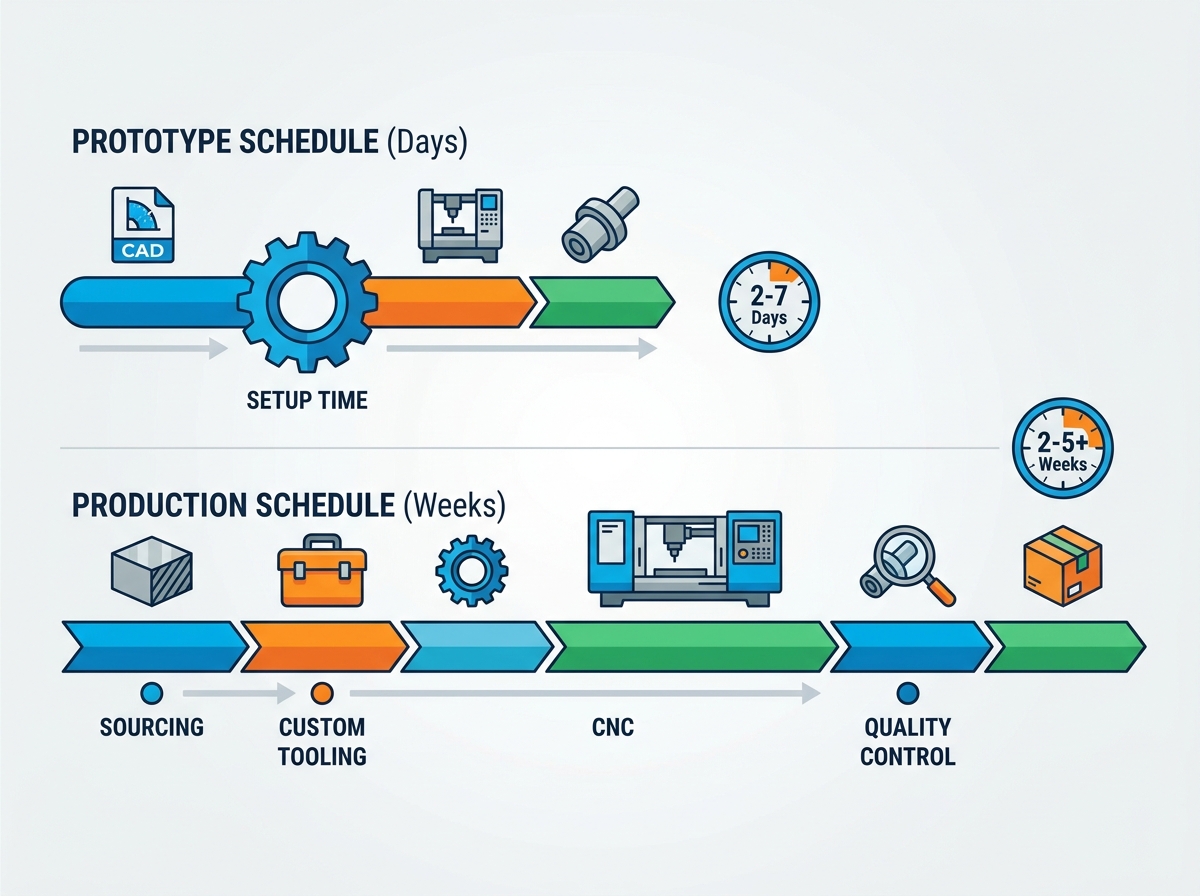
Prototype lead times prioritize speed over cost-efficiency, typically ranging from 2 to 7 days, while production runs (2–5+ weeks) require extensive upfront planning to optimize cycle times.
Part complexity, strict tolerances, and material hardness directly correlate with longer machining and inspection times.
Post-processing (like anodizing or heat treatment) and secondary operations are the most common sources of "hidden" schedule overruns.
Optimizing your CAD file for manufacturability (DFM) is the most effective lever for compressing delivery deadlines.
Understanding how manufacturing timelines shift requires viewing the process through two entirely different operational lenses. Prototyping favors rapid iteration. Production favors uncompromised repeatability. Expecting one timeline to perfectly mirror the other is a frequent source of engineering friction.
The prototype timeline strictly focuses on low-volume, rapid verification. Engineers need physical parts in hand to test form, fit, and basic function. To meet rapid turnaround windows, machine shops rely heavily on standard tooling and readily available stock materials. This bypasses the lengthy custom sourcing phase.
During prototyping, machine setup time accounts for the highest percentage of total project time. Computer-Aided Manufacturing (CAM) programming, custom fixturing, and tool selection often take longer than the actual cutting of the metal. Machinists prioritize getting the part off the machine quickly rather than optimizing the tool path for maximum long-term efficiency.
Production scheduling focuses on unit economics, strict repeatability, and massive scale. Manufacturers must optimize every single second of the cutting cycle. Saving fifteen seconds per part becomes crucial when running thousands of units. This optimization requires substantial upfront planning.
You must factor in extended lead times for custom fixtures, specialized cutting tools, and bulk raw material procurement. Bulk sourcing from mills often adds weeks to the project timeline before the first chip is ever cut.
Engineers often face the common misconception that prototype turnaround times scale linearly into volume production. This is the transition trap. High volume requires entirely different workflow sequencing. It demands rigorous quality control frameworks, such as comprehensive Coordinate Measuring Machine (CMM) routines and statistical process controls.
Phase Focus | Typical Lead Time | Primary Objective | Tooling and Setup Strategy |
|---|---|---|---|
Rapid Prototyping | 2 to 7 Days | Design Verification | Standard vises, stock materials, fast CAM programming. |
Volume Production | 2 to 5+ Weeks | Unit Cost & Scalability | Custom tombstone fixtures, optimized toolpaths, bulk sourcing. |
Every submitted CAD file undergoes a rigorous timeline calculation. Several core variables dictate whether your part ships next week or next month. Design complexity, material selection, and tolerance requirements act as the primary governors of production speed.
Simple geometric parts requiring basic 3-axis milling move through the shop queue quickly. They need fewer manual interventions. As part complexity increases, so does the necessary machine capability.
Complex parts requiring 5-axis CNC machining significantly reduce the number of manual setups on the factory floor. However, they introduce new timeline variables. 5-axis machines often require highly specialized operator scheduling. The complex CAM programming involved shifts the time burden away from the physical machine floor and directly onto the engineering desk.
Your chosen material heavily dictates the physical cutting speed and the supply chain delays.
Soft vs. Hard Metals: Soft metals like aluminum cut rapidly. They dissipate heat well, allowing for aggressive feed rates. Conversely, hard metals like titanium, tool steel, or Inconel require much slower feed rates. This prevents excessive tool wear and catastrophic tool breakage. These slower feeds naturally increase the overall cycle time per part.
Supply Chain Constraints: Exotic metal alloys or custom-sized billets inherently delay project kickoffs. Standard grades of aluminum (like 6061) or common stainless steels are typically kept in stock. Ordering rare aerospace alloys can add weeks to your timeline just waiting for the raw material to arrive.
Tolerances define how much error is acceptable. Standard tolerances (usually around +/- 0.005 inches) allow for faster, heavier machining passes. Operators can rough out material quickly.
Ultra-tight tolerances demand a completely different approach. They require slower cutting speeds to prevent material deflection. They necessitate environmental temperature controls to prevent thermal expansion during measurement. Finally, tight tolerances demand rigorous manual micrometer checks or extensive CMM inspection routines. This level of quality assurance easily adds days to your timeline.
Many project managers accurately estimate cutting times but fail to account for secondary operations. The time a part spends off the machine often rivals the time spent on it. Understanding these hidden bottlenecks prevents missed deadlines.
Parts requiring a standard "as-machined" finish can ship immediately after deburring and final inspection. However, many projects require specialized aesthetics or protective coatings. Processes requiring third-party vendors—such as Type III hard coat anodizing, powder coating, or electroless nickel plating—introduce significant transit and processing days.
External finishing shops group parts into large batches. If you miss a batch window, your parts sit idle for days waiting for the next run. Standard post-processing typically adds up to a week to your total delivery schedule.
Heat treatment alters the internal grain structure of the metal to increase hardness. This process often doubles the workflow steps. A typical sequence involves rough machining the part, sending it out for thermal cycling, and returning it for final finish machining.
Why return it for finishing? Heat treatment often causes slight material distortion. Manufacturers must leave extra stock material on the part before heating, then carefully machine away the warped layers afterward to achieve the final dimensions. This cyclical workflow severely extends lead times.
It is vital to highlight the difference between "manufacturing lead time" and "delivery lead time." A shop might finish making your parts in five days. However, cross-border shipping, unpredictable customs clearance holds, and regional freight carrier schedules must be factored into the final project deadline. Assume logistics will add at least two to four days for international orders.
Not all manufacturing partners operate with the same level of predictability. Quoted lead times are meaningless if the supplier lacks the infrastructure to guarantee them. You must vet partners thoroughly before placing purchase orders.
Machine downtime is an inevitable reality in manufacturing. Spindles crash, tooling breaks, and power fails. Does the facility have machine redundancy? If they rely on a single specialized machine to produce your parts, any maintenance issue will immediately halt your production line. Additionally, assess their internal raw material inventory against their reliance on just-in-time local suppliers.
Fast manufacturing lead times begin with fast quoting. If a shop takes five days simply to return a price, they will likely struggle with production agility. Top-tier providers offer automated quoting systems or highly responsive engineering feedback. This allows teams to resolve design-for-manufacturability (DFM) conflicts quickly before any metal is cut.
Reliable CNC machining services prioritize clear, upfront communication. They will explicitly state which processes they handle in-house versus what they outsource to external vendors. A trustworthy partner provides realistic, buffered delivery windows rather than promising unachievable best-case scenarios to win a bid.
You do not have to be at the mercy of factory schedules. Engineering teams possess significant power to compress lead times through intentional design choices. By optimizing CAD files before submission, you remove the most common manufacturing hurdles.
Sharp internal corners are impossible to mill without specialized techniques. Design internal pocket corners that perfectly match standard end-mill sizes. Better yet, make the corner radius slightly larger than the tool radius. This prevents the tool from dwelling in the corner and chattering. Avoiding custom tooling or slow, specialized tool paths drastically speeds up the cutting process.
Do not apply a blanket tight tolerance across an entire part just to be safe. Over-tolerancing is the fastest way to increase both cost and lead time. Apply strict Geometric Dimensioning and Tolerancing (GD&T) solely where components physically interface. Allow standard, looser tolerances elsewhere to speed up both the machining passes and the final quality assurance checks.
If rapid prototyping is your primary goal, do not insist on final production materials if they are hard to cut. Accept a highly machinable surrogate material for early form-and-fit testing. Using Aluminum 6061 instead of specialized D2 tool steel allows shops to finish the physical prototype days faster, enabling quicker engineering iterations.
Never wait until the absolute final design freeze to speak with your manufacturing partner. It is highly recommended to contact a CNC engineer early in the design phase. Let them review the CAD file to identify specific cost and time drivers. Adjusting a problematic hole depth or wall thickness early takes minutes. Fixing it after placing the order takes days.
Audit your CAD for standard tool compatibility.
Identify and relax any unnecessary tight tolerances.
Select readily available stock materials for initial prototypes.
Review finishing requirements to eliminate unneeded secondary operations.
CNC lead times are a predictable calculation. They rely heavily on your specific design complexity, material properties, and required operational workflows. Lead time is rarely just a measure of factory backlog. By acknowledging the distinct differences between rapid prototyping and volume production, teams can better plan their go-to-market strategies.
The lowest quoted lead time is only valuable if it comes with a high probability of execution. Balance your need for speed with strict quality compliance. Partner exclusively with manufacturers who prioritize transparent communication, early DFM integration, and verifiable production capacity. When you proactively design for manufacturability, you take firm control over your delivery schedules.
A: Typically, it takes 3-7 days for prototypes and 2-4 weeks for production. The exact timeline depends heavily on the specific aluminum grade, part geometry complexity, and the required surface finish.
A: Yes, many shops offer expedited services for prototypes, sometimes delivering in 24-48 hours. They achieve this by shifting queue priorities and utilizing overnight shipping, though this incurs a significant premium.
A: Standard post-processing usually adds 3 to 7 business days to the manufacturing schedule. This buffer factors in vendor transit times, batching processes, chemical application, and final curing times.


