


close
Choose Your Site
Global
Social Media
Views: 0 Author: Site Editor Publish Time: 2026-10-08 Origin: Site


Treating a Request for Quote (RFQ) as a simple administrative chore is a costly mistake. Instead, you should frame it as a critical technical handover between your engineering team and your manufacturing partner. Vague RFQs routinely lead to inflated contingency pricing, frustrating production delays, or outright "no-bid" responses from top-tier suppliers. When you leave details open to interpretation, vendors must guess your intent. They will naturally pad their estimates to cover potential risks.
A rigorous RFQ standardizes supplier evaluation. It forces every vendor to quote based on exact engineering terms rather than risky assumptions. This standard creates a reliable baseline, allowing you to compare bids fairly and accurately. You want apples-to-apples comparisons, not a confusing mix of best-guess estimates.
This checklist provides a proven framework for your procurement process. You can use it to lock in accurate pricing, protect intellectual property, and accelerate lead times. Following these steps ensures your manufacturing partners have exactly what they need to succeed.
A complete RFQ requires both 3D CAD models (for CAM programming and machine time estimation) and 2D drawings (for GD&T, threads, and tolerances).
Over-tolerancing is the leading cause of inflated quotes; specifying standard tolerances where applicable drastically reduces costs.
Clearly defining lot sizes, target lead times, and post-processing requirements prevents hidden fees and delivery bottlenecks.
Requesting material test reports (MTRs) and First Article Inspection (FAI) reports upfront filters out low-compliance suppliers.
Manufacturers hate uncertainty. When they receive an RFQ missing critical details, they face a difficult choice. They can either pause the quoting process to ask clarifying questions, or they can pad their quotes. Most choose the latter to mitigate risk. They add buffer costs to account for worst-case scenarios regarding tool wear, setup times, and scrap rates. You end up paying for their uncertainty.
This lack of clarity creates extreme quote variance. Consider a scenario where you request custom CNC machined parts but fail to specify a surface finish. Supplier A might quote based on a standard "as-machined" finish. Supplier B might assume you need bead blasting and clear anodizing. When you review these bids, you are comparing apples to oranges. The lowest bid often wins, only for hidden costs to emerge later when the parts do not meet your unstated expectations.
Furthermore, incomplete RFQs trigger the "no-bid" risk. Elite machine shops operate at near-maximum capacity. They carefully evaluate incoming RFQs to determine which projects are worth their engineering time. If your package lacks essential files or specifications, they will simply reject it. High-quality vendors prefer clients who demonstrate professional engineering practices.
Sending only screenshots instead of native CAD files.
Using vague material descriptions like "steel" or "plastic".
Failing to specify critical mating surfaces.
Leaving quantities open-ended or undefined.
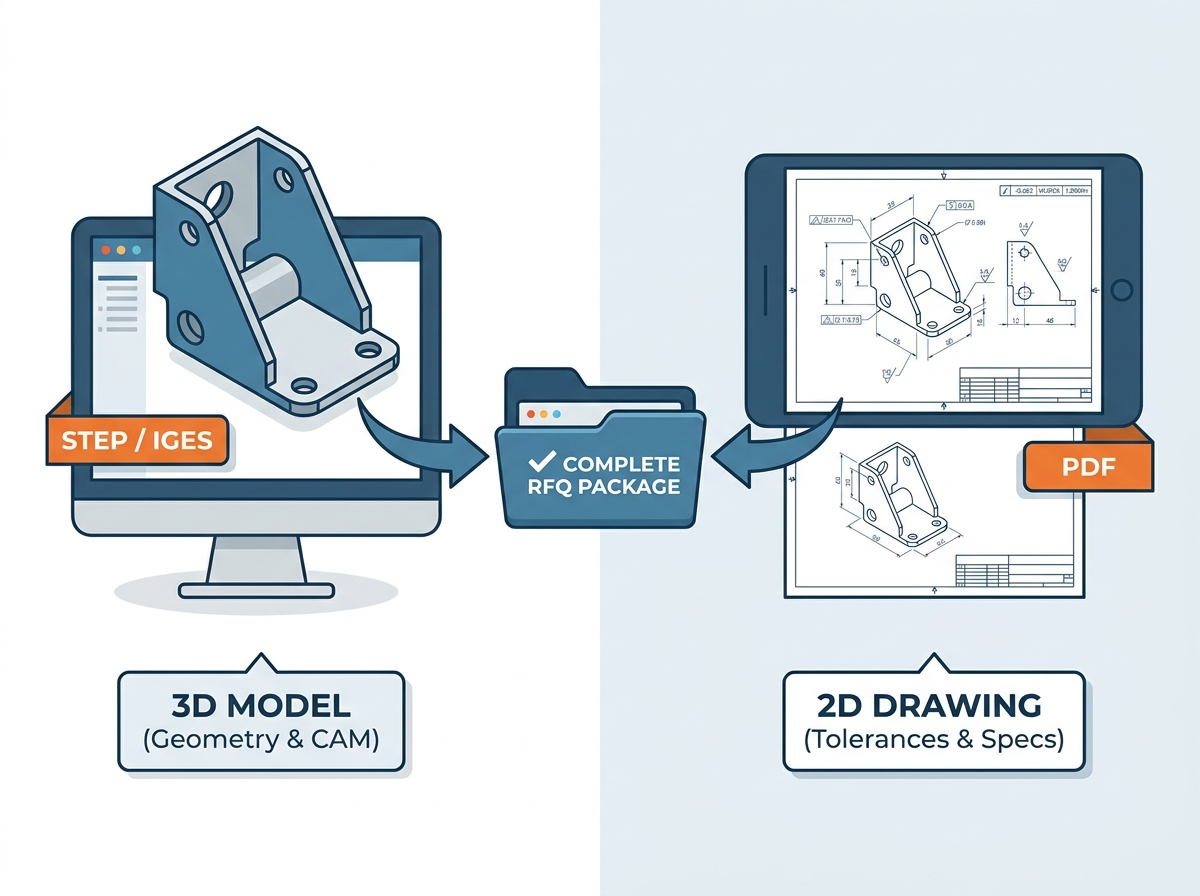
Your technical package serves as the absolute foundation of your quote. You must provide clear, accessible, and industry-standard files. We categorize these requirements into "The What" and "The How." Both are non-negotiable for a pristine manufacturing handover.
The 3D model shows the vendor exactly what they need to make. You must specify industry-standard neutral formats, such as STEP (.stp) or IGES (.igs). Avoid sending proprietary formats unless you confirm the vendor uses the same software natively. 3D models dictate CAM (Computer-Aided Manufacturing) toolpath generation. They allow machinists to determine setup counts, estimate raw material block sizes, and calculate precise machining time. An accurate STEP file speeds up the quoting process dramatically.
Many novice buyers assume a perfect 3D model is sufficient. It is not. 3D models cannot convey tolerances, threaded holes, or specific surface finishes. You must mandate PDF 2D drawings alongside your 3D files. The 2D drawing acts as the binding legal contract for part quality. It tells the machinist how to inspect the part and which features matter most. Always include a clean, readable PDF to accompany your STEP file.
Geometric Dimensioning and Tolerancing (GD&T) communicates functional intent. It provides a standardized language for defining how features relate to one another. Using proper GD&T (such as ASME Y14.5 standards) helps you avoid unnecessary precision requirements. Instead of holding an entire part to a massive tolerance, you can specify exactly which surfaces require flatness, perpendicularity, or true position. This targeted approach keeps manufacturing costs under control while guaranteeing part functionality.
Your material and tolerance choices directly dictate the manufacturing method, tool selection, and overall cost. Ambiguity here ruins budgets and timelines.
Never use generic material requests. Simply writing "Aluminum" or "Stainless Steel" guarantees a rejected or flawed quote. You must require specific alloys and tempers. For example, specify Aluminum 6061-T6 versus 7075-T6. These two alloys possess vastly different machinability ratings and raw material costs. 7075-T6 offers higher strength but costs more and takes longer to machine. Precise callouts allow the vendor to source raw materials accurately and select optimal cutting speeds.
Material Specification Callout Examples
Generic Request (Avoid) | Explicit Callout (Recommended) | Why It Matters |
|---|---|---|
Aluminum | AL 6061-T6 | Clarifies temper, yields better machinability estimates. |
Stainless Steel | 316L Stainless | Defines corrosion resistance needs and tool wear expectations. |
Plastic | Delrin (Acetal Homopolymer) | Prevents substitution with cheaper, dimensionally unstable plastics. |
Tolerances operate on an exponential cost curve. As tolerances get tighter, costs skyrocket due to specialized tooling, slower feed rates, and rigorous inspection requirements. We recommend using standard block tolerances for all non-critical features. You can reference standards like ISO 2768 (fine or medium) directly in your title block. Reserve tight tolerances (e.g., +/- 0.001 inches) strictly for mating parts, bearing presses, or critical dimensions. Over-tolerancing a cosmetic edge wastes money instantly.
Complex parts often require secondary hardware. You must explicitly detail the need for items like Helicoil inserts, PEM nuts, or dowel pins. More importantly, you must define the supply chain for these items. Specify whether the supplier will procure and install this hardware, or if the buyer will supply them as a "kit" for the shop to install. Failing to clarify this leads to purchasing delays and missing line items on the final invoice.
A part is rarely finished the moment it leaves the milling machine. Secondary operations represent a significant portion of total costs and lead times. Your RFQ must separate the machining requirements from the finishing requirements.
You must differentiate between an "as-machined" state and secondary operations. For as-machined parts, specify the required Ra (Roughness Average) value. A standard finish is typically Ra 3.2 µm (125 µin), while a smoother finish like Ra 1.6 µm (63 µin) requires a slower finishing pass. If you need applied finishes—such as Type II anodizing, powder coating, or passivation—state this clearly. Include the relevant military or industry specifications (e.g., MIL-A-8625 for anodizing) to ensure compliance.
Finishing processes often interfere with part functionality. Anodizing adds a non-conductive layer, and powder coating adds physical thickness. You must instruct buyers to clearly indicate masking requirements on the 2D drawing. If threaded holes need to remain bare to maintain thread pitch, or if a specific surface requires electrical conductivity, mark it explicitly. Custom masking is labor-intensive; vendors need to know about it upfront to quote accurately.
Many buyers forget what happens after the parts are manufactured. If your parts require pre-assembly into subsystems, state it in the RFQ. Do you need laser marking for part numbers or batch codes? Specify the font size and location. Furthermore, specify protective packaging. If parts cannot touch during transit to avoid scratching, demand custom foam inserts or individual bagging. The supplier must capture these labor and material costs early.
Your commercial terms are just as important as your technical specifications. Vendors build their business models around volume and schedule predictability.
Machining relies heavily on setup times. Programming the machine and securing the fixtures takes the same amount of time whether you make one part or one hundred. We advise submitting requests for tiered pricing. Ask for a prototype run of 10, a short production run of 100, and a scaled run of 1,000. This strategy helps you evaluate the supplier's scalability. It also shows you how effectively they amortize setup costs across larger volumes.
Differentiate between standard lead times and expedited delivery. Standard lead times typically range from two to six weeks, depending on complexity and finishing. Expedited delivery requires shops to run overtime or bump other jobs, which carries a premium charge. Frame your timeline realistically. Unrealistic timelines severely restrict your pool of viable suppliers, leaving you with desperate shops rather than capable ones.
Never assume shipping is included. You must define shipping terms using standardized Incoterms (e.g., FOB, EXW, DAP). If you use EXW (Ex Works), you handle the freight pickup and assume all transit risks. If you use DAP (Delivered at Place), the vendor handles the freight. Clarifying these terms determines who absorbs freight costs and customs risks, preventing nasty surprises at delivery.
Once you distribute your technical package, you must evaluate the responses logically while protecting your proprietary designs.
Your CAD models contain vital intellectual property. Do not distribute them carelessly. Mandate executing a Non-Disclosure Agreement (NDA) before you request a CNC machining quote, especially for proprietary hardware. Reputable suppliers will sign standard NDAs without hesitation. This legal layer protects your designs from unauthorized sharing or replication.
Do not wait until parts fail to check a vendor's quality standards. Ask for compliance upfront. Require proof of certifications relevant to your industry. Look for ISO 9001:2015 for general quality management. If you work in aerospace, demand AS9100. If you handle defense articles, verify their ITAR registration. Establishing these baselines filters out unqualified shops immediately.
When dealing with reputable CNC machining services, verbal promises regarding quality are insufficient. Outline exactly what documentation you demand in the quote return. You should typically request:
First Article Inspection (FAI) reports: Verifies the first part meets all drawing specs before full production begins.
Certificate of Conformance (CoC): A formal document stating all parts meet your required standards.
Material Test Reports (MTRs): Traceable proof of the raw material's chemical and physical properties.
When quotes return, apply a rigorous shortlisting framework. First, reject outlier low bids. These usually indicate the vendor missed a critical specification, ignored finishing requirements, or plans to substitute cheap materials. Second, scrutinize tooling and setup line items for transparency. A trustworthy quote separates non-recurring engineering (NRE) costs from the piece-part price. This transparency allows you to see exactly where your money goes.
A meticulous RFQ remains your strongest defense against cost overruns, delivery delays, and quality failures. When you provide comprehensive 3D models, explicit 2D drawings, precise material callouts, and clear commercial terms, you empower suppliers to do their best work. You eliminate the guesswork that inflates prices.
Treat your RFQ as a living document. As you interact with different machine shops, listen to their feedback. If multiple vendors ask the same clarifying question, update your master drawing package to address it. Continuous improvement in your RFQ process directly translates to better manufacturing outcomes.
Do not send out another vague email request. Use the strategies outlined in this checklist to audit your current drawing packages. Ensure every tolerance, finish, and material grade is explicitly defined before submitting your next project to a manufacturing partner. Clear communication today prevents catastrophic failures tomorrow.
A: You should submit a neutral 3D CAD format like STEP (.stp) or IGES (.igs). These formats integrate seamlessly with modern CAM software for toolpath generation. Always pair your 3D model with a PDF 2D drawing to communicate tolerances and threads.
A: Vague RFQs cause massive price variations. If you fail to specify exact tolerances, material grades, or surface finishes, suppliers make their own assumptions. Some will quote the cheapest possible method, while others will pad the quote to cover worst-case scenarios.
A: Yes, absolutely. 3D models lack the ability to convey critical thread data, specific geometric tolerances, and surface finishing instructions. The 2D drawing acts as your legal inspection document and tells the machinist exactly what features matter most.
A: Volume significantly reduces the price per part due to setup cost amortization. Programming the machine and setting up fixtures take the same time regardless of quantity. Spreading those fixed setup costs over a larger production run drives down the individual unit price.


